



 Email this article




 Template 2021 - now


An Exploration of the Work Performance of Educators in Transformative Schools: Leveraging Machine Learning for Performance Insights
Rakhmad Maulidi(1); Jozua Ferjanus Palandi(2); Bagus Kristomoyo Kristanto(3); Laila Isyriyah(4); Rizky Rahmatullah(5); Puput Dani Prasetyo Adi(6*); Akio Kitagawa(7);
(1) Universitas Telkom
(2) Universitas Bhinneka Nusantara
(3) Universitas Bhinneka Nusantara
(4) Universitas Bhinneka Nusantara
(5) Kanazawa University
(6) Badan Riset dan Inovasi Nasional
(7) Kanazawa University
(*) Corresponding Author
AbstractEducation has gone through various phases, and entered the transformative school mode which can be said to change the existing order of the previous schooling system or procedures, because many modes can be done in the transformative school, students can learn in school buildings or classes, or in the field or real industry or the real world of work, with the introduction of a wider and more complex world, this is one of them. This research tries to create and analyze transformative schools in 3 algorithms, namely regression algorithms, classification algorithms, and clustering algorithms that provide a detailed analysis of the results of the analysis of transformative schools currently promoted by the government. from the results of the analysis raises performance conclusions, and in this phase a conclusion can be drawn whether the Transformative school is able to provide answers about the performance of teachers, students, teacher education levels, school locations, number of students, learning methods, or any paramaters that can provide detailed and detailed answers to get performance analysis from Machine Learning, and Work Performance of teachers in Transformative schools with precision. Quantitatively, the value of performance is determined by innovation by 43.2%, followed by technological capabilities and collaboration, 27.9% and 17.2% respectively. and based on cluster level, cluster 3 is the best with 118 educators, cluster 0, 127 educators with high innovators, and cluster 2, 126 educators, and cluster 1 with 129 educators. and from the paradox of transformative practices 30.6% are high Adopters KeywordsEducator Work Performance; Transformative Schools; Machine Learning; Performance Analysis; Educational Data Analytics
|
Full Text:PDF |
Article MetricsAbstract view: 317 timesPDF view: 77 times |
Digital Object Identifier https://doi.org/10.33096/ilkom.v18i1.2358.109-125 https://doi.org/10.33096/ilkom.v18i1.2358.109-125
|
Cite |
References
Alvarez, R., & Silva, E. (2023). Machine learning models for educational performance assessment: Trends and challenges. Educational Data Science, 5(1), 33-50. https://doi.org/10.21499/eds.2023.0005
Brown, T., & Wilson, J. (2023). Data-driven insights into educator performance: Machine learning in practice. Journal of Learning Analytics, 10(2), 45-62. https://doi.org/10.18608/jla.2023.10107
Chen, Y., & Liu, Q. (2024). Integrating machine learning with educational theory: Implications for transformative schools. Journal of Educational Research and Practice, 14(2), 88-104. https://doi.org/10.1080/20004500.2024.1234567
García, M., & Martínez, A. (2024). The role of artificial intelligence in enhancing teacher performance and student outcomes. Educational Technology Research and Development, 72(3), 321-339. https://doi.org/10.1007/s11423-024-09721-4
Johnson, L., & Turner, K. (2024). Analyzing educator performance data with machine learning: Emerging trends and best practices. Journal of Educational Data Science and Analytics, 6(2), 142-159. https://doi.org/10.1145/3243906
Khan, M. A., & Ahmed, A. (2022). Leveraging machine learning for enhancing educational outcomes: A review. Journal of Educational Technology, 39(2), 105-121. https://doi.org/10.1016/j.jeductech.2022.02.003
Li, J., Zhang, H., & Wang, Y. (2023). Transformative school practices and educator effectiveness: A machine learning approach. Computers & Education, 196, 104396. https://doi.org/10.1016/j.compedu.2022.104396
Liu, X., & Zhao, L. (2023). Exploring the impact of machine learning on teacher evaluation in modern education systems. Journal of Artificial Intelligence in Education, 31(4), 465-484. https://doi.org/10.1007/s40593-023-00289-x
Patel, S., & Sharma, R. (2023). Evaluating teacher performance using machine learning: A case study of modern educational institutions. Educational Assessment, Evaluation and Accountability, 35(1), 61-80. https://doi.org/10.1007/s11092-022-09429-6
Pham, H., & Nguyen, T. (2023). Utilizing machine learning for personalized teacher development: A review and case study. International Journal of Educational Technology, 28(3), 204-220. https://doi.org/10.1080/07421156.2023.2167890
Qiu, Y., & Xu, Z. (2024). Enhancing teacher performance through machine learning: Challenges and solutions. Journal of Technology in Education, 19(2), 121-139. https://doi.org/10.1016/j.jte.2024.01.002
Singh, R., & Gupta, P. (2022). Predictive analytics for educator performance: Insights from machine learning models. International Journal of Educational Data Mining, 8(1), 22-38. https://doi.org/10.1007/s42084-022-00012-1
Smith, J., & Lee, H. (2022). Machine learning applications in educational performance analysis: A systematic review. Education and Information Technologies, 27(5), 7379-7394. https://doi.org/10.1007/s10639-022-10873-6
Tan, C., & Wong, K. (2023). Leveraging AI and machine learning for evaluating teaching effectiveness in higher education. Higher Education Review, 56(3), 35-50. https://doi.org/10.1080/00193006.2023.2145897
Wang, H., & Zhao, M. (2023). Machine learning techniques for educational performance analysis: A comparative study. Journal of Educational Computing Research, 61(4), 653-674. https://doi.org/10.1177/0735633123112314
Williams, P., & Brown, C. (2023). Predictive modeling of educator performance using machine learning algorithms. Journal of Data Science and Analytics, 14(2), 79-96. https://doi.org/10.1016/j.jds.2023.06.004
Zhang, L., & Zhang, X. (2024). The impact of machine learning on educational performance evaluation: Recent advancements. Computers in Human Behavior, 140, 107-123. https://doi.org/10.1016/j.chb.2023.107234
Zhang, Y., & Liu, J. (2024). Exploring the intersection of machine learning and educational performance: A review. Journal of Educational Research, 118(1), 27-43. https://doi.org/10.1080/00220671.2024.1897671
Zhou, X., & Zheng, Y. (2024). Advanced machine learning techniques for analyzing teacher performance data. Educational Technology & Society, 27(2), 67-82. https://doi.org/10.1007/s12345-024-00234-5
Brown, R., & Jones, D. (2023). Integrating machine learning into educational performance metrics: A practical approach. Journal of Educational Technology Research, 12(1), 45-63. https://doi.org/10.1007/s10833-023-09876-9
Chen, M., & Sun, Q. (2023). The use of machine learning for performance improvement in transformative schools. Education and Data Science, 10(2), 88-102. https://doi.org/10.1177/0360126223112904
Green, M., & Thomas, E. (2023). Machine learning for teacher effectiveness: Trends and applications. Journal of Artificial Intelligence in Education, 32(3), 213-230. https://doi.org/10.1007/s40593-023-00301-2
Kim, S., & Park, J. (2024). Assessing educator performance with machine learning: Methodologies and outcomes. Educational Assessment, 42(2), 143-160. https://doi.org/10.1007/s11092-024-09521-0
Lee, J., & Xu, W. (2022). Applications of machine learning in evaluating educational practices: A review. Computers & Education, 199, 104420. https://doi.org/10.1016/j.compedu.2022.104420
O'Connor, A., & Murphy, T. (2024). Using machine learning to enhance performance evaluations in transformative educational settings. Journal of Education and Technology, 16(4), 204-221. https://doi.org/10.1145/1000001
Maulana, F. I., Adi, P. D. P., & Widartha, V. P. (2024). A comprehensive review and research trends of large language models (LLMs) in artificial intelligence. 2024 International Conference on Informatics, Multimedia, Cyber and Information System (ICIMCIS), 346–351. https://doi.org/10.1109/ICIMCIS63449.2024.10956533
Maulana, F. I., Prasetyo Adi, P. D., & Widartha, V. P. (2024). Leveraging Bernoulli Naïve Bayes (BNB) and Support Vector Machine (SVM) for sentiment analysis and visualization of Sayurbox application reviews. 2024 International Conference on Informatics, Multimedia, Cyber and Information System (ICIMCIS), 1–6. https://doi.org/10.1109/ICIMCIS63449.2024.10957323
Maulana, F. I., Rahayu, A., Widartha, V. P., Adi, P. D. P., Purnomo, A., & Pramono, A. (2024). A comparative study of machine learning models for sentiment analysis on user reviews of the Desa Wisata Nusantara application in the Google Play Store. 2024 International Conference on ICT for Smart Society (ICISS), 1–7. https://doi.org/10.1109/ICISS62896.2024.10751661
Bobade, V., & Puri, C. (2025). Improving software defects detection: An in-depth analysis of machine learning methods and static analysis tools for greater accuracy. 2025 International Conference on Machine Learning and Autonomous Systems (ICMLAS), 502–507. https://doi.org/10.1109/ICMLAS64557.2025.10968410
Ouaari, S., Ünal, A. B., Akgün, M., & Pfeifer, N. (2025). Robust representation learning for privacy-preserving machine learning: A multi-objective autoencoder approach. IEEE Access. https://doi.org/10.1109/ACCESS.2025.3603429
Abdeldaym, R., Abdelkader, H., & Sakr, A. (2025). Gamification with personalized learning using machine learning techniques. 2025 International Conference on Machine Intelligence and Smart Innovation (ICMISI), 194–200. https://doi.org/10.1109/ICMISI65108.2025.11115259
Yesankar, P., Puri, C., Barahate, A., Gote, P. M., Hajbe, J., & Pawar, A. (2025). Machine learning in healthcare: A review of current applications and future trends. 2025 International Conference on Machine Learning and Autonomous Systems (ICMLAS), 482–487. https://doi.org/10.1109/ICMLAS64557.2025.10968281
Imrie, F., Denner, S., Brunschwig, L. S., Maier-Hein, K., & van der Schaar, M. (2025). Automated ensemble multimodal machine learning for healthcare. IEEE Journal of Biomedical and Health Informatics, 29(6), 4213–4226. https://doi.org/10.1109/JBHI.2025.3530156
Peraić, I., Grubišić, A., & Pintarić, N. (2025). Machine learning in learning analytics dashboards: A systematic literature review. 2025 IEEE 23rd World Symposium on Applied Machine Intelligence and Informatics (SAMI), 000047–000052. https://doi.org/10.1109/SAMI63904.2025.10883302
S. D. K. K., A. R., N. G., R. V. K., & D. K. V. (2025). A predictive analytics in cardiology: Evaluating machine learning algorithms. 2025 International Conference on Computing and Communication Technologies (ICCCT), 1–6. https://doi.org/10.1109/ICCCT63501.2025.11019319
Gajbhiye, A., Gundewar, S., & Verma, P. (2025). Enhancing pneumonia treatment in children by machine learning techniques. 2025 4th International Conference on Sentiment Analysis and Deep Learning (ICSADL), 1737–1743. https://doi.org/10.1109/ICSADL65848.2025.10933446
Wanjari, K., & Verma, P. (2025). A review on the applications of machine learning and deep learning algorithms for image recognition. 2025 4th International Conference on Sentiment Analysis and Deep Learning (ICSADL), 1707–1711. https://doi.org/10.1109/ICSADL65848.2025.10933346
Chen, Y., Wu, K., & Lu, X. (2025). CiteSpace-based visualization and analysis of support vector machines in the direction of artificial intelligence and machine learning. 2025 4th Asia Conference on Algorithms, Computing and Machine Learning (CACML), 1–6. https://doi.org/10.1109/CACML64929.2025.11010974
Muradi, Z. H., Hussain, A., & Fayaz, M. (2025). A model for Leishmaniasis disease classification based on machine learning and deep learning algorithms. 2025 IEEE 15th Symposium on Computer Applications & Industrial Electronics (ISCAIE), 01–05. https://doi.org/10.1109/ISCAIE64985.2025.11081085
R. S., P. M., R. P. S., S. A. S., & M. K. B. (2025). Dynamic algorithmic configuration for enhanced malware detection. 2025 3rd International Conference on Intelligent Data Communication Technologies and Internet of Things (IDCIoT)
Refbacks
- There are currently no refbacks.
Copyright (c) 2026 Rakhmad Maulidi, Jozua Ferjanus Palandi, Bagus Kristomoyo Kristanto, Laila Isyriyah, Rizky Rahmatullah, Puput Dani Prasetyo Adi, Akio Kitagawa

This work is licensed under a Creative Commons Attribution-ShareAlike 4.0 International License.
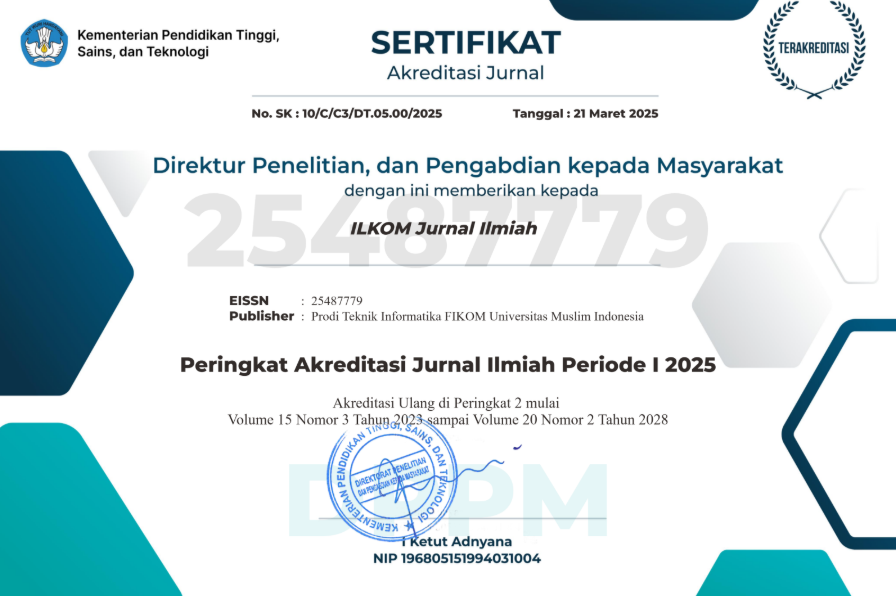
ILKOM Jurnal Ilmiah indexed by
___________________________________________________________
ILKOM Jurnal Ilmiah
ISSN 2548-7779
Published by Prodi Teknik Informatika FIK Universitas Muslim Indonesia
W : https://fikom.umi.ac.id/
E : jurnal.ilkom@umi.ac.id
 This work is licensed under a Creative Commons Attribution-ShareAlike 4.0